Coding Tasks
The coding board turns a written brief into merged code with as little ceremony as you want: write what you need, either plan it into reviewable phases with an interactive planning agent or one-shot it, watch the agent work in its own git worktree, review the diff with line-anchored comments, and merge. Every stage is a column; every task is a card.
The sidebar keeps a slim TASKS section near the top — a pulse row summarizes the board (9 planned · 1 in progress · 2 to review) with an orange badge counting cards waiting in Testing/Review and a red badge when an agent needs your input. Click the section title or the row to open the board, or press ⇧⌘T anywhere.
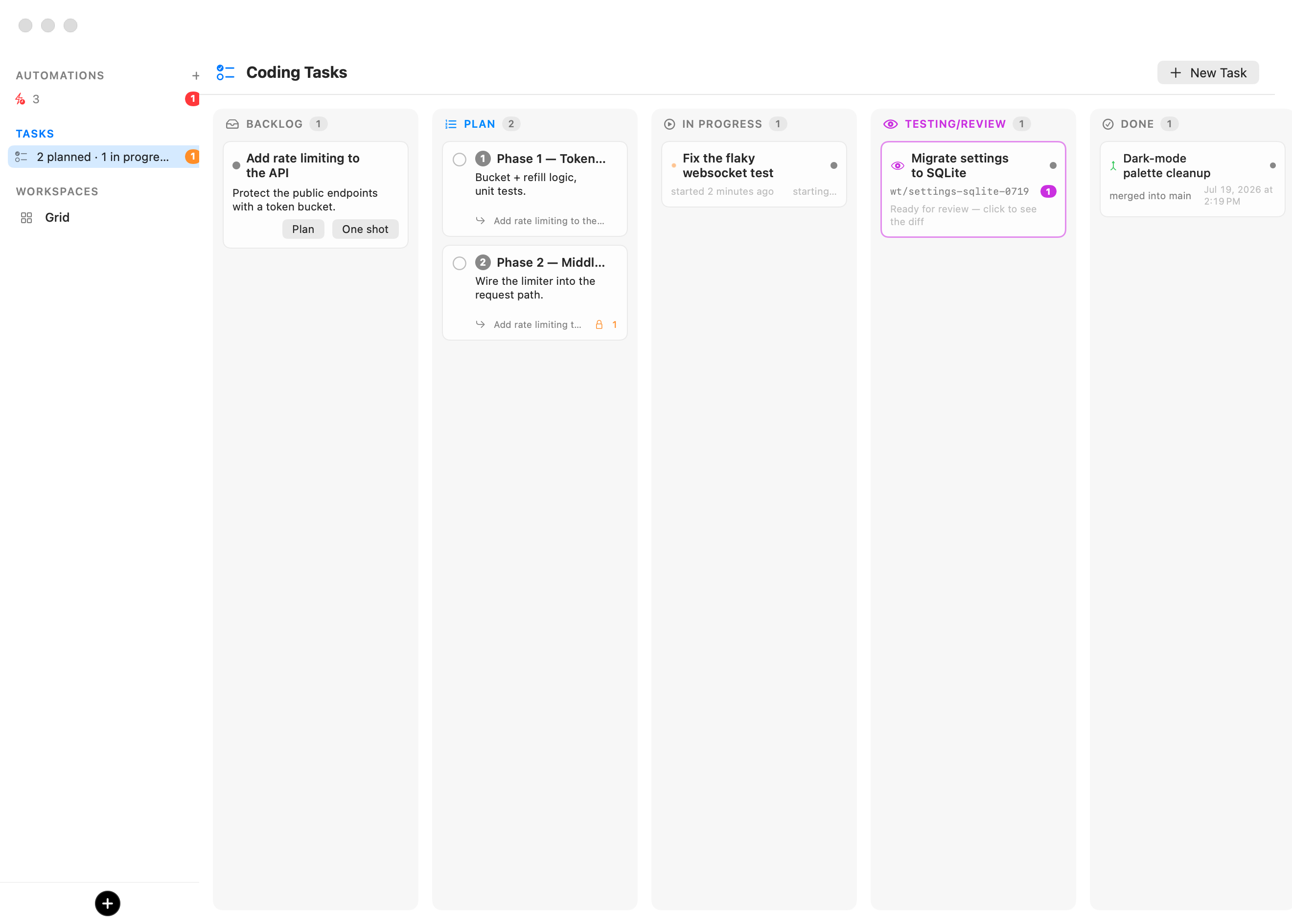
| Column | What sits there |
|---|---|
| Backlog | Briefs you have written but not started. Each card offers Plan and One shot. |
| Plan | Phase cards a planner agent filed from a brief — numbered, dependency-aware, multi-selectable. |
| In Progress | Phases and one-shot tasks an agent is actively working on, each in its own worktree. |
| Testing/Review | Finished work waiting on you: the card opens the review window with the branch's diff. |
| Done | Merged, pull-requested, or closed-without-merge tasks. |
Everything on this page works identically from a remote rich client — the board, the planning window, and the review window all mirror over the control API.
Writing a task
+ New Task (or clicking a backlog card) opens the editor:
- Title and a description written in Markdown, with a Write / Preview toggle. The brief becomes the agent's prompt, so write it like one.
- Workspace and Agent — the task runs inside the chosen workspace with one of its configured agents.
- Start the agent in — a folder inside the workspace. When it is a git repository of its own, the task runs in a fresh worktree and branch there.
- Create folder & git repo if needed — for greenfield work: starting or planning first runs
mkdir+git init(with an empty root commit) when the folder is not already its own repository. Leave it off for a folder inside an existing repo.
A brief in the Backlog offers two buttons:
- One shot sends the task straight to In Progress: the agent does the whole thing autonomously and hands you the diff in Testing/Review.
- Plan opens a planning session first.
Planning
Plan launches a visible, interactive planning session and opens its window — a native conversation view, no terminal required. The session opens on your brief, rendered as a card; the agent explores the repository read-only, narrates what it finds, and asks questions when the brief leaves real choices open.
Questions arrive as a tabbed card — one tab per question, exactly mirroring the picker the agent shows in its own session. Answers are collected locally and stay editable until you press Submit, which sends the whole set at once; a mis-click is never final. You can also type free-form answers in the composer at the bottom of the window, or press Open Terminal to watch the raw session.
When the agent has what it needs, it files the plan onto the board — ordered phase cards in the Plan column, each roughly one reviewable pull request of work, with dependencies between them — and records a plan overview. The window then shows Plan is ready with the phase count and a Close button, the planning session's tab closes itself, and the brief leaves the Backlog (its phases supersede it; delete them all and it returns).
Planning is watched: if the workspace reboots, the agent is quit, or the session dies before phases are filed, the card's spinner ends with a specific reason — click Plan to retry — instead of spinning forever.
The Plan column
Phase cards are numbered in plan order and carry:
- A dependency badge (a lock with phase numbers) when the phase needs earlier phases Done first.
- A queued badge when you started it before its dependencies finished — it starts automatically the moment they are all Done.
- Their parent brief's name.
Select multiple phases with the checkboxes and the selection bar appears: Start N selected one-shots each of them (dependency-gated phases queue), Clear drops the selection, and Delete removes the whole selection behind one confirmation. Editing a phase shows its Depends on list — every sibling phase with a checkbox, so dependencies can be reworked by hand.
Phases run fully autonomously — no interactive input is expected once started.
In Progress
A started task boots the workspace if needed, creates a fresh worktree of the repository, and launches the agent with the brief as its prompt. The card shows a live agent-status dot, when it started, and Needs your input in red if the agent is blocked on a question — clicking the card jumps to the live session. The sidebar's TASKS badge counts these so you never miss one.
When the agent reports done, the task moves to Testing/Review, and its terminal tab closes on its own — a finished session is not left squatting in the tab strip. If the agent crashes instead, the card turns red rather than pretending to work.
Testing/Review
The Testing/Review card opens the review window: the branch's full diff against its parent, read live from the VM, with per-file expanders, add/remove counts, and any plan the agent recorded.
Review like a pull request:
- Line comments: hover any added or context line and click the margin bubble to attach a comment to that exact line; anchored comments render under their lines. File-level and general comments work too.
- Send Back to In Progress delivers every drafted comment to the agent — formatted as In
foo.js, line 196: use a different method — and the task returns to In Progress for another round. The agent resumes on the same worktree and branch. - Merge — the split button's default merges into the parent branch; hold it for Squash & Merge, Create Pull Request… (when the workspace has a GitHub token), or merging into any other branch. A clean merge closes its own terminal tab; conflicts open a resolver session instead.
- Close Without Merging discards the round while keeping the record in Done.
Tip: The same line-comment workflow exists outside the board: when the active tab runs a coding agent, the file explorer diff pane grows the same margin bubbles, and Send to agent batches your comments straight into that session — code review without ever creating a task.
Removing cards
Every card grows a ✕ on hover (and a Remove from board context-menu entry), behind a confirmation. For cards with real work behind them the dialog offers a choice: Stop Agent & Delete Worktree (In Progress) or Delete Worktree & Branch (Testing/Review) tears everything down, while Remove Card Only leaves the session and checkout untouched in the workspace.
Storage and API
Tasks persist in one file next to the workspace store, with atomic writes and ISO-8601 dates:
~/Library/Application Support/BromureAC/tasks.json
The whole board is mirrored on the app's control socket for rich clients and scripts:
| Endpoint | Purpose |
|---|---|
GET /tasks | List every task. |
POST /tasks | Create or update (upsert) a task document. |
POST /tasks/<id>/start | Start it (worktree + agent). |
POST /tasks/<id>/plan | Launch the planning session. |
POST /tasks/<id>/comment | Add a review comment (text, optional file and line). |
POST /tasks/<id>/send-back | Deliver unsent comments and return the task to In Progress. |
POST /tasks/<id>/merge | Merge (squash, optional target). |
POST /tasks/<id>/open-pr | Create a pull request instead of merging. |
POST /tasks/<id>/to-testing, /to-in-progress | Move it by hand. |
POST /tasks/<id>/destroy | Stop the agent, delete the worktree and branch, remove the card. |
DELETE /tasks/<id> | Remove the card only. |
Under the hood, the planning and task agents talk back to the board through a per-session board MCP server (vsock, host-side): board_get_task, board_set_plan, board_create_subtasks, and board_ready_for_review are how phases get filed and how a finished task announces itself — no polling, no scraping. The tools are wired automatically for every supported agent: Claude Code loads a per-branch MCP config, Codex gets per-invocation mcp_servers overrides, and Grok reads a project-scoped .grok/settings.json written into the session's checkout (and excluded from its diff).