Folders
The Folders pane lists the folders on your Mac that are shared into this workspace's VM. A shared folder is the bridge between your real filesystem and the sandbox: it is where the agent reads the code it works on and writes the changes it makes. Everything else the VM touches — its home directory, its system disk — is disposable and isolated; a shared folder is not. It is a live, read-write window into your Mac.
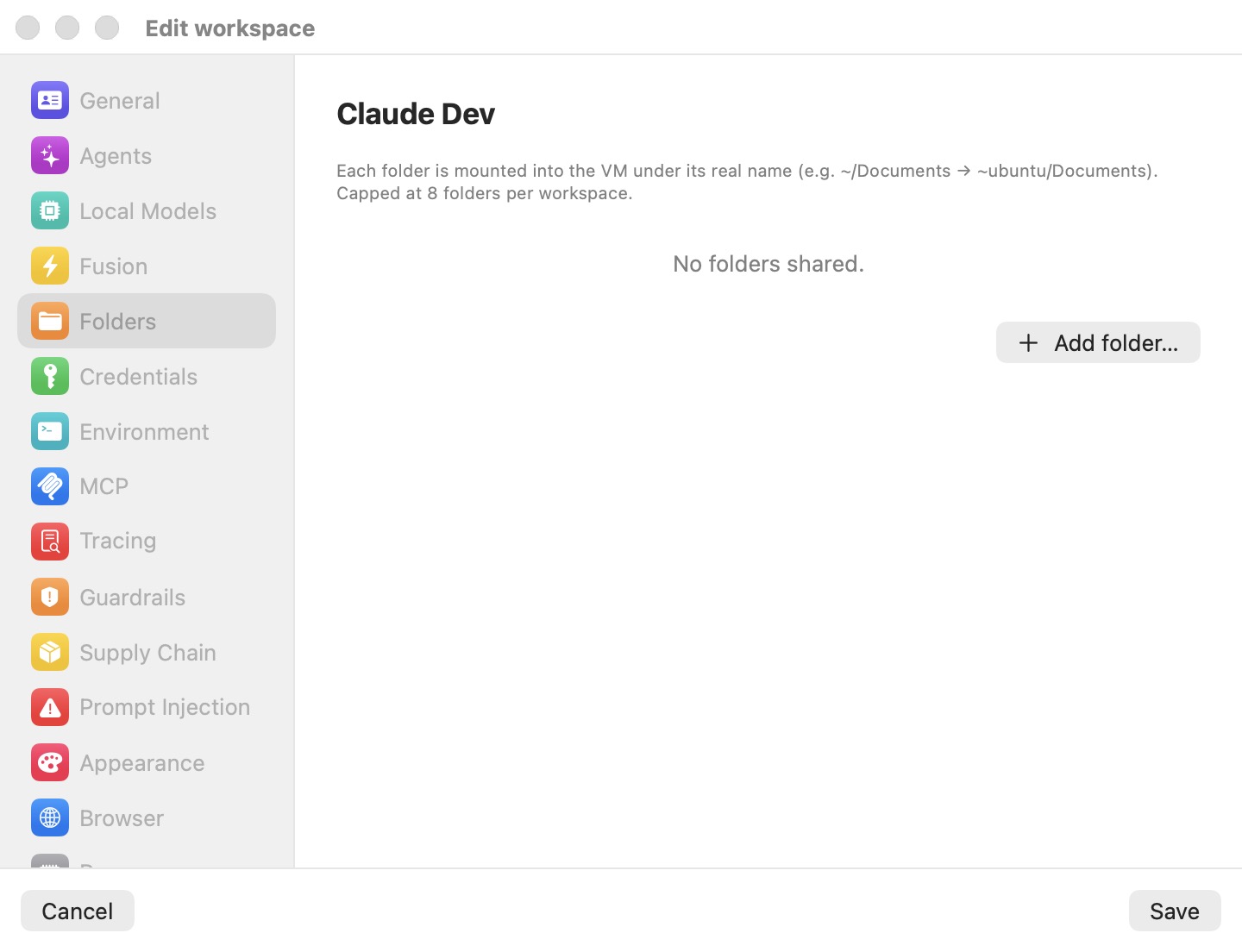
The pane's caption states the rule exactly: Each folder is mounted into the VM under its real name (e.g. ~/Documents → ~ubuntu/Documents). Capped at 8 folders per workspace. With no folders configured it reads No folders shared.
How folders are shared
Each folder you add is attached to the VM as a virtiofs share and mounted at /home/ubuntu/<basename>, where <basename> is the folder's own name. Sharing ~/Documents makes it appear inside the VM as ~ubuntu/Documents (that is, /home/ubuntu/Documents); sharing ~/code/bromure appears as /home/ubuntu/bromure. Only the last path component is used for the mount name, so two folders with the same basename from different locations would collide — give one of them a distinct directory name if you need both.
The share is read-write. The agent inside the VM can create, modify, and delete files in a shared folder exactly as a local process on your Mac could, and those changes are immediate and permanent on the host side. This is what makes the workspace useful: the agent edits your working copy in place, and git, your editor, and your other tools on the Mac see the edits as they happen.
Because shares are attached when the VM is configured at startup, a change to this list applies the next time the workspace's VM boots. Adding or removing a folder while a session is running does not hot-plug it — save the change, then restart the session to pick it up.
Warning: A shared folder is not part of the sandbox. It survives everything that resets the VM. Deleting a workspace explicitly leaves it alone — the confirmation dialog reads "The mounted host folder is untouched." — and if a workspace is ever flagged compromised and wiped, its shared folders are not wiped and may still hold files the agent wrote. Share only the folders the agent actually needs, and review a shared folder by hand after any compromise event. See Credentials & the wire boundary for the compromise flow.
Adding and removing folders
To share a folder, click Add folder… at the bottom of the pane. This opens a directory picker in which you can select one or more folders at once; each selected directory becomes a new row. The button is disabled once the workspace already has eight folders — the per-workspace maximum.
Each configured folder appears as a row showing the folder's name and its full path on your Mac. Click the minus button on a row to stop sharing that folder; removing a row here never deletes the folder or its contents on the host — it only detaches it from the VM at the next boot.
The list of currently shared folders is also visible from the running session: the session window's info panel shows a Shared folders list so you can confirm at a glance what the agent can reach. See Sessions.
Settings reference
| Setting | Type | Default | Description |
|---|---|---|---|
| Folder list | List of host paths | Empty | Each row shows the folder name and its full host path, with a minus button to remove it. Mounted read-write at /home/ubuntu/<basename>. |
| Add folder… | Directory picker (multi-select) | — | Adds one or more folders. Disabled once eight folders are configured. |
Related chapters
- Concepts — how the VM, its disposable layers, and virtiofs shares fit together.
- Sessions — the running session window and its shared-folders list.
- Credentials & the wire boundary — what a compromise wipe does and does not touch.
- Settings Reference — all panes at a glance.