Settings Reference
Every setting in Bromure Agentic Coding belongs to a single workspace: each workspace carries its own agents, credentials, security policies, appearance, and VM resources, edited in one place — the settings editor. The only exceptions are the Automation pane (app-wide, stored in application preferences), the downloaded browser image, and downloaded local models (both shared across workspaces).
This chapter is the reference for the editor itself and for all sixteen panes. Each pane has its own page with a screenshot, a settings table with defaults, and pointers to the deep-dive chapter that explains the underlying feature.
Opening the settings editor
There are four ways into the editor:
- Toolbar gear — with a workspace selected in the main window, click the gear icon in the toolbar (tooltip Edit workspace).
- Sidebar context menu — click the ⋯ menu on a workspace row in the sidebar and choose Edit….
- New workspace — click the + button at the bottom of the sidebar (tooltip New workspace). This opens the same editor as a New workspace window, pre-filled from your preferences template; the confirm button reads Create instead of Save.
- Preferences — choose Preferences… from the app menu (⌘,). This opens the editor bound to the preferences template (see below) and adds the app-wide Automation pane.
When editing an existing workspace, the window is titled Edit workspace. Only one editor window exists at a time — opening settings for a different workspace replaces the current editor window.
The editor window
The editor is a two-pane window: a sidebar of categories on the left, each with a colored gradient icon, and a scrolling detail pane on the right. Cancel (or Esc) discards your changes; Save (or Create) applies them.
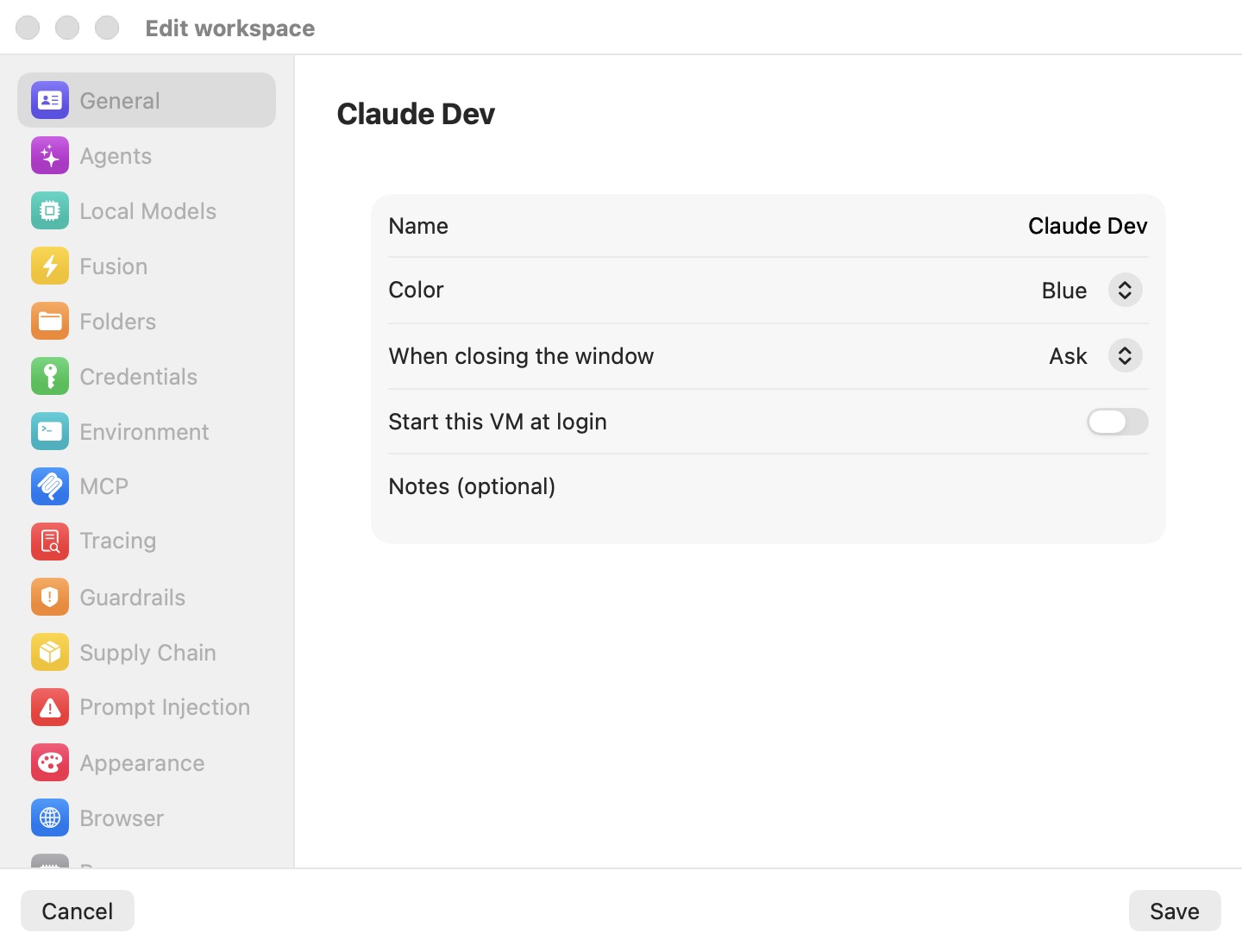
Saves are transactional per window — nothing is applied until you click Save or Create. A few actions have immediate side effects regardless, because they operate on shared or external state: local-model downloads and removals (global, shared across workspaces), prompt-injection model downloads, MCP OAuth authorization, subscription Register… / Forget, SSH-key import, and everything in the Automation pane (which writes app preferences live).
Secrets you type anywhere in the editor are never written to the plain-text profile.json. On save they are split into secrets.enc, AES-GCM-encrypted with a master key held in the macOS Keychain, with file permissions 600. See Credentials & the wire boundary for the full model.
The preferences template ("Defaults")
Opening the editor from Preferences… does not edit any workspace — it edits a template workspace forcibly named Defaults (the Name field is hidden). Every new workspace is forked from this template, so anything you set there — agents, credentials, guardrails, appearance — becomes your personal default for future workspaces.
The factory template ships with Claude Code enabled as the primary agent in Subscription (interactive login) mode, every guardrail set to Prompt before write, and the session trace level at AI request details. The defaults quoted throughout this chapter are these factory values; if you have edited Preferences, new workspaces inherit your values instead.
Note: The Automation pane is app-wide, not per-workspace. It only appears when the editor is opened via Preferences…, and its changes take effect immediately rather than on save.
The panes
| Pane | What it configures |
|---|---|
| General | Workspace name, accent color, window-close behavior, start at login, and notes. |
| Agents | Which coding agents (Claude Code, Codex, Grok Build, Kimi Code, Oh My Pi) are available, which one is primary, and how each authenticates. |
| Local Models | On-device inference: the master switch, Local/Hybrid routing, and the MLX model catalog with downloads. |
| Fusion | Multi-model answer synthesis (BETA): which models to fuse and which model judges. |
| Folders | Host folders shared into the VM at /home/ubuntu/<basename> (up to 8). |
| Credentials | Git identity, SSH keys, forge tokens, cloud and database credentials — all held on the host and swapped fake→real on the wire. |
| Environment | Plain KEY=VALUE variables exported into every VM shell. |
| MCP | Model Context Protocol servers, translated into each enabled agent's native config and injected at boot. |
| Tracing | How much the proxy records, private mode on enrolled Macs, and subscription token-swap status. |
| Guardrails | Host-side write policies per resource: Off, Prompt before write, Block destructive, or Read-only. |
| Supply Chain | Package-fetch defenses: age gate, OSV lookups, socket.dev or Depi filtering, install-script stripping, and lockfile prompts. |
| Prompt Injection | On-device detection of injected or rogue instructions in the agent's AI traffic. |
| Appearance | Terminal font, cursor, colors, and window opacity. |
| Browser | The embedded agent-drivable Chromium: profile persistence and browser-image management. |
| Resources | The three storage layers, VM RAM, and NAT or bridged networking. |
| Automation | App-wide (Preferences only): the loopback HTTP automation API and the bromure-cli mcp server. |
Where settings are stored
Per-workspace settings live in ~/Library/Application Support/BromureAC/profiles/<uuid>/profile.json, with secrets in the adjacent encrypted secrets.enc. The preferences template is stored as profile-template.json plus profile-template.enc next to the profiles directory — deliberately outside it, so it never appears in the workspace sidebar. The Automation pane writes app-wide preferences (UserDefaults) rather than any profile file.