Environment
The Environment pane sets plain environment variables that are exported into every shell in the workspace's VM. These are non-secret configuration knobs — log levels, feature flags, build toggles — that you want present in the agent's environment without wiring up any swap or credential machinery.
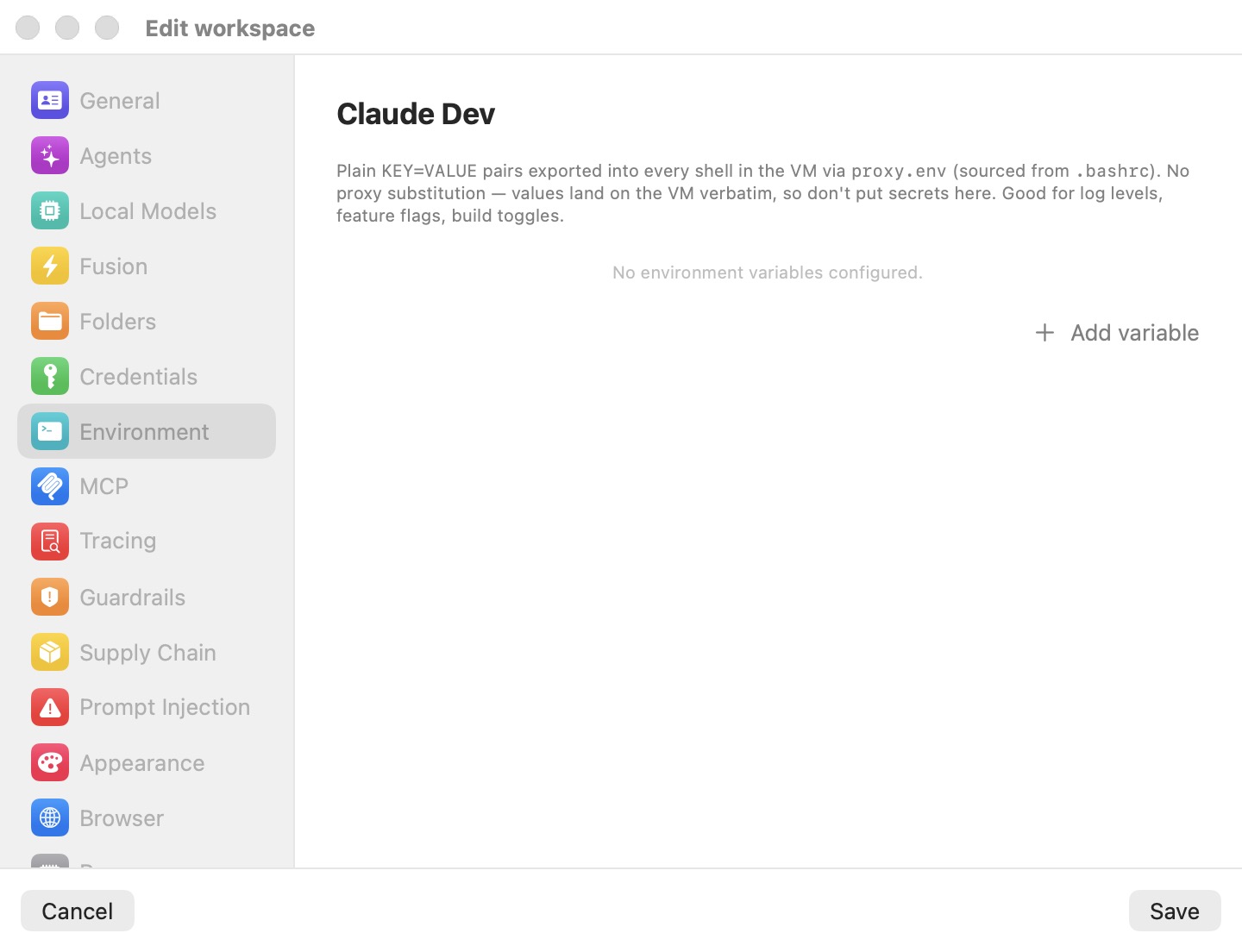
The pane's caption states both what it does and what it is not for: Plain KEY=VALUE pairs exported into every shell in the VM via proxy.env (sourced from .bashrc). No proxy substitution — values land on the VM verbatim, so don't put secrets here. Good for log levels, feature flags, build toggles. With nothing configured it reads No environment variables configured.
How variables are exported
Each variable you add is written to proxy.env, a file on the workspace's metadata share that the managed .bashrc sources for every shell. That means the value is present in every terminal tab, every command the agent runs, and every login and non-login shell — verbatim, exactly as you typed it. There is no brm_… fake and no wire swap: this pane is a straight pass-through, which is precisely why secrets do not belong here.
If you need the VM to hold a token or password, use the Credentials pane instead. Anything defined there is injected as a fake and swapped to the real value on the wire; a secret typed into the Environment pane would instead land inside the sandbox in cleartext.
Adding and editing variables
Click Add variable to append a row. Each row is a Name field and a Value field, with a minus button to remove it.
The name is validated against the shell identifier rule [A-Za-z_][A-Za-z0-9_]* — it must start with a letter or underscore and contain only letters, digits, and underscores. A name that does not match shows an inline orange warning and is not exported. The value is unconstrained and is used exactly as written.
Tip: Group related toggles in one workspace and leave a scratch workspace bare. Because these variables are per-workspace, a workspace tuned for verbose debugging (
RUST_LOG=debug,NODE_ENV=development) stays separate from one configured for a clean production-like build.
Live refresh on a running session
Editing this pane and saving does not require a VM restart. Bromure Agentic Coding bumps an internal env.generation counter and re-writes proxy.env; new shells opened after the save re-source it and see the updated values immediately. A foreground agent that is already running keeps the environment it started with until it exits — a new prompt (or a new tab) picks up the change.
Although these values are non-secret by intent, they are still stored in the workspace's encrypted secrets.enc blob on save, alongside the pane's other data, rather than in the plain-text profile.json.
Settings reference
| Setting | Type | Default | Description |
|---|---|---|---|
| Variable list | List of Name = Value rows | Empty | Each row exports one variable into every VM shell via proxy.env. Name must match [A-Za-z_][A-Za-z0-9_]*, or it shows a warning and is skipped. Values are used verbatim — no substitution. |
| Add variable | Button | — | Appends a new empty row. |
Related chapters
- Credentials — where secrets belong; injected as fakes and swapped on the wire.
- MCP — configuring tool servers, some of which read environment variables.
- Settings Reference — all panes at a glance.