Resources
The Resources pane configures the virtual machine behind a workspace: how its disks are laid out, how much memory it gets, and how it reaches the network. It is divided into three groups — Storage, Memory, and Network — matching the three things every workspace VM needs.
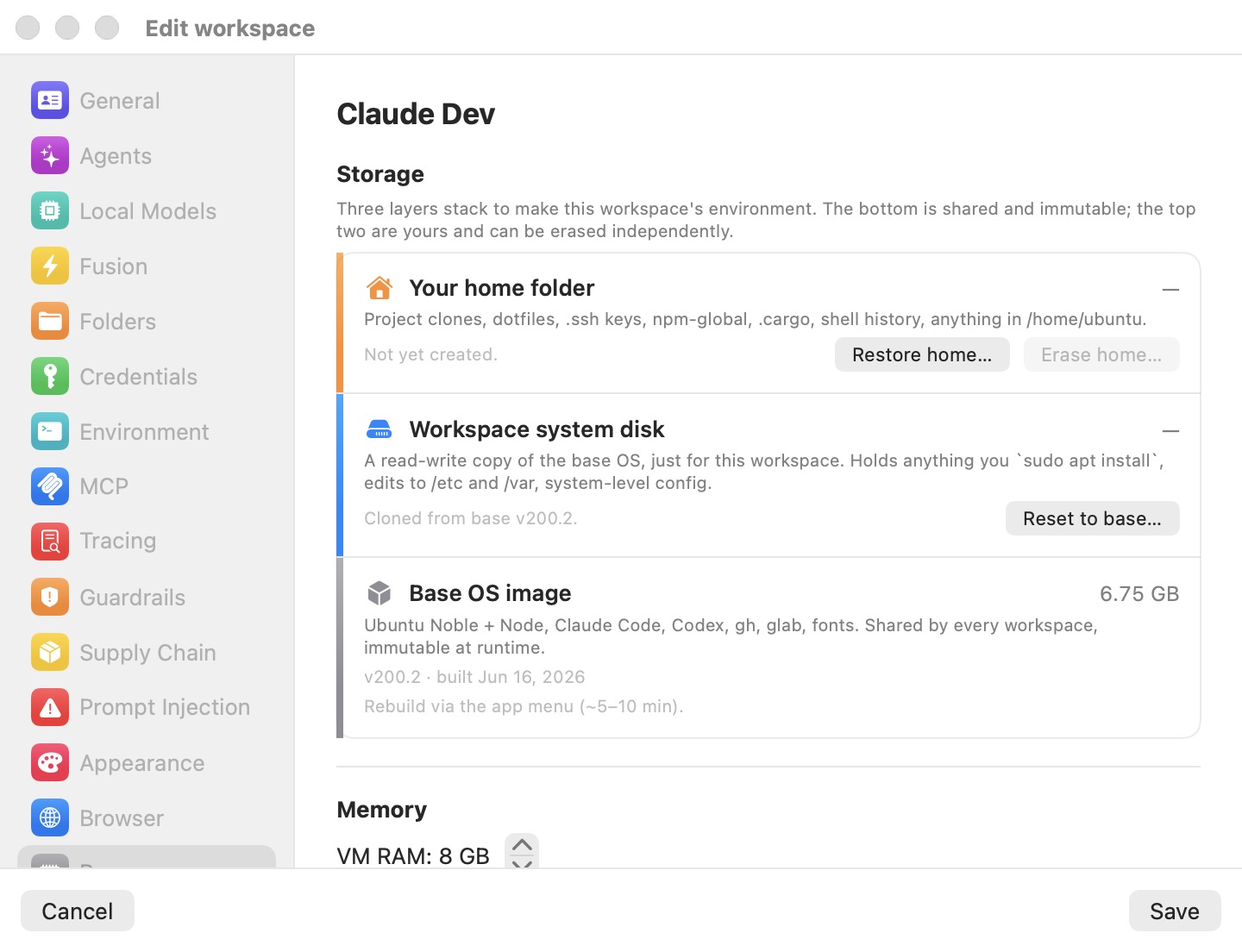
The storage controls act on a real workspace's disks, so they only appear once a workspace exists. In the preferences template (Bromure → Preferences…), where there is no VM to act on, the pane explains that storage controls apply to real workspaces and shows the memory and network settings only — those still seed every new workspace.
Storage
A workspace's filesystem is built from three stacked layers. As the pane puts it: the layers stack to make this workspace's environment; the bottom is shared and immutable, and the top two are yours and can be erased independently. Each layer is a row in the stack, with its size and status on the right and, where an action is possible, a button.
Your home folder
The top layer is the persistent /home/ubuntu — project clones, dotfiles, .ssh keys, npm-global, .cargo, shell history, and anything else the agent writes to its home. On a modern workspace this lives on a private ext4 disk image that shrinks on your Mac as files are deleted inside the VM; the row's status line shows Active with a relative time and the current size, or Not yet created before the first launch.
Two actions can appear on this row:
- Erase home… (destructive) wipes the home layer. Projects, shell history,
npm-global,.cargo, and the auto-generated SSH keypair are all removed; the app's managed dotfiles are rebuilt on the next launch, and the home's rollback checkpoints are deleted too. The rest of the workspace — its system disk, settings, and imported credentials — is untouched. - A second, model-dependent slot holds either Restore home… or Upgrade storage…:
- Restore home… rolls the ext4 home image back to one of its per-boot checkpoints (each checkpoint is the home exactly as it was when that session started). The current home is checkpointed first, so a restore can itself be undone. This is the same rollback described in Sessions.
- Upgrade storage… appears only on a legacy workspace whose home is still a shared host folder. It re-arms the one-time migration to the ext4 image, which then runs on the next boot with progress shown on the boot screen; the old home is kept on your Mac as a backup.
Workspace system disk
The middle layer is a read-write copy of the base OS, cloned just for this workspace. It holds anything you sudo apt install, edits to /etc and /var, and other system-level configuration. The status line shows which base version it was cloned from (for example, Cloned from base v200.2).
Reset to base… (destructive) discards every system-level change and re-clones the disk from the current base image. Your home folder is left intact — only the OS layer is replaced. Because a fresh disk cannot resume against an old memory snapshot, resetting also clears any saved RAM state and tab layout, so the next start is a clean boot. This is the same action as Reset disk in the sidebar; see Workspaces.
Base OS image
The bottom layer is the shared, immutable base image — Ubuntu Noble plus Node, Claude Code, Codex, gh, glab, and fonts — cloned by every workspace and read-only at runtime. The row shows its version, build date, and on-disk size. There is no per-workspace action here: rebuilding the base affects every workspace, so it lives in the app menu instead, noted on the row as Rebuild via the app menu (~5–10 min).
Note: The two destructive buttons are disabled while the workspace's session window is open — the tooltip reads Close the session window first. — and for a workspace that has never launched, where the disks do not exist yet (Created on first launch.). Close the session before resetting or erasing.
Memory
The VM RAM stepper sets the memory allocated to this workspace's VM, from 2 to 32 GB in steps of 2. As the caption suggests, raise it if Claude or Codex feels sluggish or a Rust build runs out of memory.
The default is scaled to your Mac's own memory: 4 GB on hosts with less than 18 GB of RAM, 6 GB up to 36 GB, and 8 GB on larger machines. The VM's CPU allocation is fixed at 4 vCPUs and is not configurable here.
Tip: For a niche need you can also change the ext4 home image's apparent size before a workspace's first boot with
defaults write io.bromure.agentic-coding vm.homeImageGB -int <N>(8–1024 GB, default 64). The image is sparse, so a larger apparent size costs nothing until the guest actually writes that much.
Network
The Network group is a radio choice between two modes:
- NAT (default) — the VM sits behind NAT. Egress works, and nothing on your LAN can reach it. All NAT-mode workspace VMs share one private network segment, so a workspace and its browser VM, or two workspaces, can reach each other's dev servers by IP — see Concepts. The caption reads: VM sits behind NAT. Egress works; nothing on your LAN can reach it.
- Bridged — the VM joins your physical LAN and gets its own LAN-routable IP address via DHCP.
Bridged mode and the interface picker
Choosing Bridged reveals an Interface picker listing the Mac's physical network interfaces; the VM bridges onto the one you select, defaulting to the first available. The caption confirms: The VM gets a LAN-routable IP via DHCP on the chosen interface.
If the Mac has no interface available for bridging, an orange warning appears — No bridged interfaces available. Bromure AC will fall back to NAT at launch. — and the workspace launches in NAT mode instead. Bridged networking depends on the virtualization networking entitlement, so it is available only in a properly signed build.
Settings reference
| Setting | Type | Default |
|---|---|---|
| Your home folder — Erase home… | Destructive button (disabled while running / before first launch) | — |
| Your home folder — Restore home… / Upgrade storage… | Button (model-dependent; disabled while running) | — |
| Workspace system disk — Reset to base… | Destructive button (disabled while running / before first launch) | — |
| Base OS image | Read-only row (version, build date, size) | — |
| VM RAM | Stepper, 2–32 GB in steps of 2 | Host-scaled: 4 GB (host under 18 GB), 6 GB (under 36 GB), 8 GB (36 GB or more) |
| Network mode | Radio: NAT / Bridged | NAT |
| Interface (bridged only) | Picker of physical interfaces | First available (falls back to NAT if none) |
The disk, home, and checkpoint files described here live under ~/Library/Application Support/BromureAC/profiles/<uuid>/; the Concepts chapter explains the copy-on-write clone model, and Sessions covers suspend, resume, and home checkpoints in depth.