CLI, Automation & MCP
Everything you can do in the app, you can also do without the window. The same binary that hosts the GUI — bromure-cli, inside Bromure Agentic Coding.app/Contents/MacOS/ — is a full multi-command CLI, an HTTP control plane, two MCP servers, an AppleScript dictionary, and a scheduler. This chapter is the reference for all of them.
Four automation surfaces sit on top of one control plane:
- The
bromure-clicommand line — a Docker/kubectl-style CLI for creating workspaces, booting VMs, attaching terminals, running commands, and reading traces. - The automation API — the same control plane exposed as JSON-over-HTTP on the loopback interface, for scripting from any language.
- MCP servers — a stdio server that lets an AI agent (Claude Code, Claude Desktop) manage the app, and a
browserserver that lets an agent drive its workspace's embedded Chromium. - AppleScript — the Bromure AC Suite dictionary, for macOS scripting and screenshot tooling.
Scheduled automations — recurring, unattended agent runs — build on the same control plane and are covered at the end of the chapter.
The control plane: socket and API
Every one of these surfaces ultimately speaks HTTP to the running app over one of two transports:
| Transport | Where | Access gate | On by default |
|---|---|---|---|
| Control socket | ~/Library/Application Support/BromureAC/control.sock (Unix domain, HTTP/1.1) | File permissions — the socket is mode 0600, owner-only. Reaching the file is the authorization, Docker-socket style. | Yes, whenever the app or a headless agent is running |
| Automation API | 127.0.0.1:9223 (TCP) | Loopback only by default; introspection and mutation routes additionally require the BROMURE_DEBUG_CLAUDE environment variable (see Debug endpoints) | No — opt-in in Preferences → Automation |
The CLI never talks to a VM directly. Each subcommand is a thin HTTP client over the control socket, so the same commands work locally and — when the socket is tunneled over SSH — against a remote instance from a rich client. If no agent is running when you invoke a command that needs one, the CLI autostarts a windowless background agent (bromure-cli run --headless) and waits up to 40 seconds for it to answer /health. Read-only commands (vm ls, describe, trace …) do not autostart; they print No bromure-cli agent running. instead.
Note: The control socket is always available while the app runs and is independent of the Enable automation server switch. That switch only governs the TCP listener on port 9223. You do not need to enable the automation API to use the
bromure-cliCLI.
The bromure-cli command line
You can call the binary by its full bundle path, but the app offers a one-time install of a short alias. At launch it shows an alert — Install the "bromure-cli" command-line tool? — with buttons Install / Not Now / Don't Ask Again. Choosing Install symlinks /usr/local/bin/bromure-cli to the app binary (one admin prompt). Under the bromure-cli name the binary hides app-internal commands — image management, the mcp server, and the GUI run default — and exposes only the terminal-facing groups (Workspaces, Tracing, Local inference, Enterprise, remote); a bare bromure-cli prints help instead of launching the app. Invoked as bromure-cli, everything is available and the default subcommand is run (the GUI). The examples below use bromure-cli; substitute bromure-cli freely for the commands it exposes.
Commands accept a workspace id, a short-id prefix, or its name wherever a workspace argument is shown. Workspaces are the persistent VM configurations described in Workspaces; the vm and workspaces command groups are aliases for each other.
The app and the background agent
| Synopsis | What it does |
|---|---|
bromure-cli run [--headless] | Default (hidden) subcommand — launch the GUI. --headless runs a window-less menu-bar accessory agent; this is what the CLI autostarts to serve the control socket. |
Image management
The base image is installed once. These commands are hidden under the bromure-cli alias.
| Synopsis | What it does |
|---|---|
bromure-cli init [--build-local] | Install the Ubuntu base image: download the prebuilt image, falling back to a roughly 10-minute local build on download failure. --build-local forces the local build. |
bromure-cli info | Print the base-image version, virtual size, on-disk size, and path. |
bromure-cli reset [--yes] | Delete the base image (disk, EFI vars, version stamp, state) so the next init starts fresh; confirms unless --yes. |
bromure-cli init-foss-image --output <dir> | Publish pipeline only — build the redistributable free-software-only base image into <dir>. |
bromure-cli verify-image --disk <path> [--timeout 300] | Publish pipeline only — boot a disposable clone headless and require the serial login prompt within the timeout. |
Note: There is no
setupsubcommand — that belongs to the sibling Bromure (browser) product. The Agentic Coding image install command isinit. If no base image exists, launching the GUI routes you into the in-app setup flow instead.
Workspace and VM control
This is the core group. vm run is deliberately Docker-shaped: it boots a workspace and hands your terminal to the guest's shared bromure tmux session.
| Synopsis | What it does |
|---|---|
bromure-cli vm ls | List every workspace with live state (off / suspended / booting / running), uptime, window attach state, tmux tabs as a tree (* marks the active tab), and running Docker containers. |
bromure-cli vm run [<workspace>] [-v <dir>]… [--name N --tool T --auth A --api-key K] [--memory GB] [-d] [--rm] | Start a workspace's VM, or create a throwaway one on the fly. Default: attach your terminal to the guest tmux. |
bromure-cli vm attach <vm> [<tab#> | containers:<name> [-- <shell>]] [-w] | Attach the terminal to the VM's tmux (optionally jumping to a tab), docker exec -it into a running container (default shell bash), or open/reattach the GUI window with -w/--window. |
bromure-cli vm exec <vm> [-i] [-t] [--timeout 600] -- <command…> | Run a command inside the VM (kubectl-style, after --). -it opens an interactive pty; omit the command with -it for a shell. Guest exit codes propagate. |
bromure-cli vm kill <vm> [--suspend] | Stop a VM: graceful shutdown, or suspend (RAM saved to disk) with --suspend. |
bromure-cli vm reboot <workspace> [--hard] | Reboot a running workspace in place; graceful by default, --hard tears it down immediately. |
bromure-cli vm describe <workspace> | Print the workspace's settings plus live runtime details when running (state, IP, vCPUs, Fusion state, disk usage from guest df, tabs, containers, memory in use). |
bromure-cli vm ports <workspace> (or vm <workspace> -L) | Show a running workspace's listening ports (live ss as root): PORT, PROTO, ADDRESS, PROCESS, with loopback-only binds marked. |
bromure-cli workspaces create [--name N] [--tool T] [--auth A] [--api-key K] [--memory GB] [--color C] [-v <dir>]… [--generate-ssh] [--from-json <file|->] | Create a workspace headlessly. --from-json applies a full profile JSON document (flags override matching fields); --generate-ssh mints a host-side SSH key and prints the public key. |
bromure-cli workspaces edit <workspace> [--from-json <file|->] | Fetch the workspace's full config, open it in $VISUAL/$EDITOR (vi fallback), and save changes back. Secrets show blank — leave blank to keep, type to replace. --from-json applies a document non-interactively. |
bromure-cli workspaces rm <workspace> [-f] | Delete a workspace and ALL its data (disk + home) after a y/N confirmation, skipped with -f. |
bromure-cli workspaces ssh-keygen <workspace> | Generate a fresh host-side SSH key for the workspace and print the public key for your Git host. |
A few operational details worth knowing:
vm runflags.--toolisclaude,codex, orgrok;--authistoken,subscription, orbedrock.-v/--volume <hostdir>mounts a host folder at~/<basename>in the guest (repeatable, up to 8).-d/--detachboots the VM and returns instead of attaching.--rmdeletes the workspace and its disk when the VM stops. Detach from an attached tmux withCtrl-b d— that leaves the VM running.- TTY-aware. The Docker-style default of handing the terminal to tmux applies only on a real terminal; piped or scripted invocations silently behave as if you passed
-d. workspaces createauth. Forcreate,--authalso acceptslocal. Colors areblue,red,green,orange,purple,pink,teal, orgray.- Blank-keep on edit.
workspaces editexports the whole config with secrets blanked; a saved-back document with a blank secret keeps the stored value, so a round-trip can never wipe your keys. An unchanged buffer saves nothing; invalid JSON aborts. - Exec waits.
vm execwaits up to 10 seconds for the guest shell agent; a502means the VM may not be running or the name did not match. Approval prompts that fire during an attached session are rendered on your terminal (see Consent over attached terminals), never inside the guest.
Models, routing, and Fusion
Local inference is covered in depth in Local Models and multi-model synthesis in Fusion; the CLI toggles are:
| Synopsis | What it does |
|---|---|
bromure-cli model catalog|ls|pull|use|rm … | Manage local MLX inference models — browse the curated catalog, download with live progress, select per workspace, remove. |
bromure-cli vm fusion enable|disable <vm> | Engage or disengage Fusion on a running VM. Requires the workspace to have two or more models configured. |
bromure-cli vm routing cloud|local|hybrid <vm> | Set the LLM backend routing for a running VM. |
bromure-cli vm hybrid budget <tokens> <vm> | ttft <seconds> <vm> | split <percent> <vm> | Tune hybrid routing: cloud-token cap per rolling 24 hours (0 = unlimited), soft time-to-first-token fallback threshold (default 5 s), and percentage of new sessions pinned to local (0–100). |
fusion also accepts on/engage and off/disengage as synonyms.
Trace inspection
These read the per-workspace MITM session traces. They return nothing unless the workspace has tracing enabled — see Tracing settings — and the full story is in Tracing.
| Synopsis | What it does |
|---|---|
bromure-cli trace ls [workspace] [--limit 50] | List recent requests: TIME / HOST / METHOD / STATUS / REQ / RESP / LAT / FLAGS (flags include swap×N, LEAK×N, conv). |
bromure-cli trace summary [workspace] | Aggregate totals, status classes, swap/leak/conversation counts, and top hosts. |
bromure-cli trace hostnames [workspace] | List distinct hosts and their request counts. |
bromure-cli trace leaks [workspace] | Show requests with suspected credential leaks (header, preview, suspicion). |
bromure-cli trace clear [-f] | Wipe in-memory and on-disk trace history after a y/N confirmation. |
Remote access
The optional SSH front door is disabled by default and documented fully in Remote Access. All operations go through the running app over the control socket.
| Synopsis | What it does |
|---|---|
bromure-cli remote [status] | Default subcommand — print enabled/running state, bind and port, auth methods, host-key fingerprint, login user, a ready-made connect line, and authorized keys. |
bromure-cli remote enable [--port 2222] [--bind 0.0.0.0] [--[no-]password] [--[no-]pubkey] | Enable the SSH server. At least one auth method must remain on. |
bromure-cli remote disable | Turn the SSH server off. |
bromure-cli remote key add <key|path> / key [ls] / key rm <index|fingerprint> | Manage authorized public keys (ls is the default). |
Enterprise enrollment
CLI counterparts of the Log in to bromure.io… sheet, for scripted device provisioning. See Enterprise.
| Synopsis | What it does |
|---|---|
bromure-cli enroll --code <6-word-code> [--server-url URL] [--device-name NAME] | Enroll this Mac with a bromure.io workspace using an admin-minted code. Server defaults to $BROMURE_MANAGED_URL or https://bromure.io/api; device name defaults to the Mac's hostname. |
bromure-cli unenroll [--force] | Sign out of the enrolled workspace (y/N unless --force). |
bromure-cli enrollment-status | Print enrollment state (workspace, user, install id, device, server, enrolled date, bearer/leaf-cert presence). "not enrolled" exits 0 so automation does not treat it as a failure. |
Integration and internal commands
| Synopsis | What it does |
|---|---|
bromure-cli mcp [--debug] [--api-url http://127.0.0.1:9223] | Run the AC MCP server on stdio for AI tools. See The AC MCP server. |
bromure-cli __remote-menu, __attach-window, __fatclient…, __forward…, __dial, __tunnel-helper | Internal entry points (the SSH ForceCommand TUI, terminal byte pump, and rich-client tunnel helpers). Not for interactive use. |
The remote TUI (__remote-menu)
When SSH remote access is enabled, every remote login is forced (via ForceCommand) into a hand-rolled ANSI terminal UI rather than a shell — an alternate-screen, 256-color minishell driven by arrow keys and digits that works over any SSH PTY (use ssh -t). It mirrors the whole CLI as menus:
- Workspaces — create with a single-screen form (Name, Tool, Auth, API key, Memory, Color, Folders, Generate SSH, Full settings…, Create), per-workspace actions (Attach, New tab, Describe, Configure…, Fusion, Routing, Worktrees…, Reboot…, Suspend, Kill for running workspaces; Start, Describe, Configure…, Delete for off ones), and a raw table view. Configure… reproduces every GUI editor pane natively.
- Models — installed models and the download catalog; picking an uninstalled model offers to
model pullit inline with live progress. - Trace — Summary / Hostnames / Leaks / Recent / Clear.
While you are attached to a workspace's tmux, a magic keychord (default Ctrl-], shown in the banner) pops a host-drawn controller overlay: a tab tree, New tab, Worktrees…, Fusion, Routing, Edit settings…, Reboot…, Suspend, Disconnect. The guest never sees the trigger key — override it with the remote/overlay-key file or $BROMURE_OVERLAY_KEY. Ctrl-b d disconnects from tmux back to the menu. The full remote and rich-client story, including the overlay and connection setup, is in Remote Access.
The loopback automation API
The control plane is also exposable as JSON-over-HTTP on TCP for scripting from any language. It is off by default.
Enabling it
Open Bromure → Preferences → Automation — the Automation API & MCP server pane.
- Turn on Enable automation server. When it is on, the pane reads Listening on 127.0.0.1:9223; turning it off stops the server immediately.
- Optionally set Port (the field is captioned (default: 9223)) and Bind address (default
127.0.0.1). Port and bind address take effect the next time the server starts — toggle the switch off and on to apply them now.
You can also flip the switch without the GUI:
defaults write io.bromure.agentic-coding automation.enabled -bool true
Warning: Setting Bind address to anything other than
127.0.0.1exposes the API — and the MCP server it backs — to the network, and the pane warns Non-loopback bind exposes the API to the network. The MCP server has no auth. There is no authentication on the TCP listener beyond the loopback boundary and theBROMURE_DEBUG_CLAUDEgate below. Leave the bind address on loopback unless you have a specific, trusted reason not to.
Authentication model
The TCP listener and the control socket serve the same routes, but with different access:
| Route group | Control socket | Automation API (TCP loopback) |
|---|---|---|
| Profile and session listing, session open/close | Allowed | Allowed |
VM control, exec, /app/state, /debug/* | Allowed | Requires BROMURE_DEBUG_CLAUDE on the app |
remote, /state, automations, grid-layout, prompts | Allowed | Control-socket only |
In other words: the control socket is the full-access, owner-only path; the TCP API opens the safe subset on loopback and gates the powerful routes behind the debug flag. Path segments are single percent-encoded (so workspace names with spaces work), and request bodies up to 8 MB are accepted.
Endpoints for scripting
The most useful routes:
| Endpoint | Transport | Purpose |
|---|---|---|
GET /health | Both | Liveness plus debugEnabled. |
GET /state | Socket | One-shot mirror snapshot: workspaces, VMs, grid layout, automations, pendingPrompts, vmnet subnet. |
GET /vms | Both | List running VMs. |
POST /vms | Both (debug-gated on TCP) | Boot a VM from a profile reference or an inline spec plus mounts. |
GET /sessions / POST /sessions | Both | List sessions; open a session for a workspace. |
GET /profiles / POST /profiles | Both | List workspaces; create one from a JSON document (?full=1 returns the whole secrets-blanked document). |
POST /vms/<id>/exec | Both (debug-gated on TCP) | Run a command in a VM; interactive hijacks the connection into a raw framed pty stream. |
GET /automations / POST /automations/<id>/run | Socket | Read and drive scheduled automations (see Scheduled automations). |
POST /prompts/<id>/answer | Socket | Answer a queued lifecycle prompt (see Answering pending prompts). |
Because the control socket path contains spaces, capture it in a variable first:
SOCK="$HOME/Library/Application Support/BromureAC/control.sock"

# Full mirror snapshot (control socket only)
curl --unix-socket "$SOCK" http://localhost/state

# List running VMs (control socket — no debug flag needed here)
curl --unix-socket "$SOCK" http://localhost/vms

# Boot a workspace by name
curl --unix-socket "$SOCK" -X POST http://localhost/vms \
  -d '{"profile":"Claude Dev"}'

# Answer a queued lifecycle prompt with one of its offered button labels
curl --unix-socket "$SOCK" -X POST http://localhost/prompts/PROMPT_ID/answer \
  -d '{"choice":"Not Now"}'
The safe subset works over the TCP API once you have enabled it — for example, listing and opening sessions needs no debug flag:
# List sessions
curl http://127.0.0.1:9223/sessions

# Open a session for a workspace
curl -X POST http://127.0.0.1:9223/sessions -d '{"profile":"Claude Dev"}'
Note:
GET /vms(listing running VMs) is available over the TCP automation API without any debug flag. Mutating VM routes —POST /vms(boot a VM) andPOST /vms/<id>/exec— requireBROMURE_DEBUG_CLAUDEover TCP; drive them over the control socket (as above) when you do not want to run the app in debug mode. The full endpoint surface — including worktree and tab actions,/trace,/remote, and the rich-client mirror routes — is summarized in the Appendix.
The AC MCP server (bromure-cli mcp)
bromure-cli mcp runs a stdio JSON-RPC MCP server (server name bromure-cli) that lets an AI tool manage the app. It wraps the automation HTTP API and AppleScript, so enable the automation server first — the session and profile-listing tools call the HTTP API at --api-url (default http://127.0.0.1:9223).
The tools it exposes:
bromure_ac_list_profiles,bromure_ac_list_sessionsbromure_ac_open_session(waits up to 30 seconds for the window),bromure_ac_close_sessionbromure_ac_get_profile,bromure_ac_set_profile(atomic JSON replace, id preserved)bromure_ac_get_profile_setting,bromure_ac_set_profile_setting(keys includename,color,comments,tool,authMode,apiKey,closeAction,memoryGB,folderPathsCount,mcpServerCount,keyboardLayoutOverride,keyRepeatDelayMs,keyRepeatRateHz)
With --debug (and BROMURE_DEBUG_CLAUDE set on the app) it adds bromure_ac_app_state, bromure_ac_vm_exec, bromure_ac_vm_read_file, and bromure_ac_vm_write_file.
To wire it into Claude Code, add the following to ~/.config/claude-code/.mcp.json (or your client's equivalent). This is the exact snippet the MCP client configuration section of the Preferences pane offers to copy:
{
  "mcpServers": {
    "bromure-cli": {
      "command": "/Applications/Bromure Agentic Coding.app/Contents/MacOS/bromure-cli",
      "args": ["mcp"]
    }
  }
}
Note: The
get/setprofile tools shell out toosascript(AppleScript against the running app), so the GUI app must be running and macOS may prompt once for Automation permission. Profile JSON travels with secrets blanked unlessBROMURE_DEBUG_CLAUDEis set.
The in-workspace browser MCP server
Separately from the AC MCP server, every workspace agent is given a browser MCP server automatically — no configuration. It drives the workspace's embedded Chromium, which runs in its own disposable VM. The workspace editor's MCP pane describes the workspace's own MCP servers; the built-in browser server is always present on top of whatever you add there.
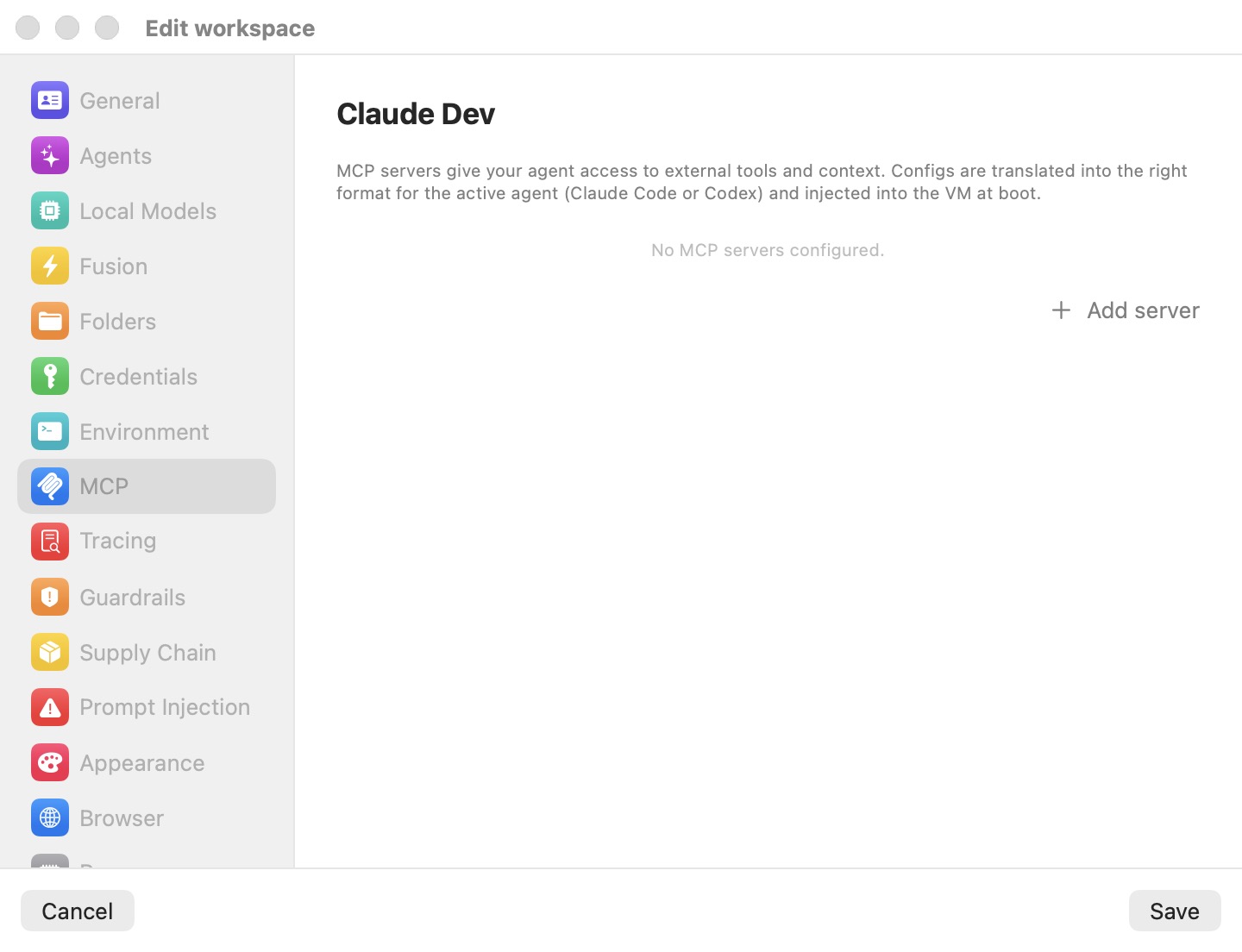
The server exposes 23 tools for navigation and inspection — browser_navigate, browser_new_tab, browser_list_tabs, browser_activate_tab, browser_close_tab, browser_back, browser_forward, browser_reload, browser_screenshot (with a full-page option), browser_evaluate, browser_get_text, browser_get_html, browser_get_links, browser_click, browser_fill, browser_type, browser_press_key, browser_wait_for, browser_network, browser_network_summary, browser_clear_network, browser_console, and browser_pick_element (an interactive 60-second element picker).
Transport is a generated Python stdio shim, bromure-browser-mcp.py, staged read-only into the guest at /mnt/bromure-meta/. It dials the host over vsock port 5830 and reconnects forever on drops, so the MCP client never withdraws the tools. A tool call against a closed browser opens it and waits for the cold boot. Because the browser is a separate VM, the server instructions warn agents to reach a workspace dev server by the workspace's LAN IP (hostname -I), never localhost.
Note: On a rich client, the agent's browser-MCP stream can be spliced over an SSH channel so a remote agent drives the browser pane you see locally. One relay is active at a time. See Remote Access.
HTTP MCP servers you add in the editor can authenticate through the host-side OAuth broker: it performs RFC 8414 discovery and RFC 7591 dynamic client registration (as Bromure AC), runs a PKCE authorization-code flow in your system browser, and serves the callback on a loopback listener (ports 28500–28599). The success page reads Authorized — You can close this tab and return to Bromure AC. The whole flow runs on the host, so the VM never sees real OAuth credentials.
AppleScript (Bromure AC Suite)
A scripting dictionary, the Bromure AC Suite, is a third automation surface — useful for orchestration and for screenshot tooling that needs window IDs. Target application "Bromure Agentic Coding" from Script Editor or osascript. It covers:
- Profiles —
list profiles,create ac profile <name> [color <c>](returns a UUID),delete ac profile <name|uuid>, and full-document round-trip viaget profile json/set profile json(the whole Codable profile; id preserved; stored secrets merged under blank fields). - Per-field settings —
get profile setting … key …/set profile setting … key … to value …. - Editor windows —
open profile manager,open ac profile editor,close ac profile editor,select editor category <key>, andget editor window id/get main window id(aCGWindowIDforscreencapture -l). - Sessions —
open ac session,close ac session,list ac sessions. - App state and settings —
get app state(JSON), plusget ac app setting/set ac app settingfor keysautomation.enabled,automation.port,automation.bindAddress,remoteAccess.enabled,remoteAccess.port,remoteAccess.bindAddress,managed.serverURL, andmanaged.acIngestURL. Settingautomation.enabledtoggles the HTTP server live.
For example, to open a session:
osascript -e 'tell application "Bromure Agentic Coding" to open ac session "Claude Dev"'
Note: Profile JSON travels with secrets scrubbed unless
BROMURE_DEBUG_CLAUDEis set. SettingapiKeyto an empty string viaset profile settingclears the key rather than keeping it — unlike the blank-keep behavior of the JSON round-trip bridges. Locale switching is deliberately not scriptable; relaunch the app with, for example,-AppleLanguages "(fr)"instead.
Scheduled automations
A scheduled automation is a recurring, unattended agent run bound to one workspace: when it fires, it creates a fresh git worktree and launches the chosen agent there with your prompt, and the run appears as an ordinary worktree tab. Automations are created and managed from the automation board (⇧⌘A, or the sidebar's AUTOMATIONS section), and the whole feature — triggers, schedule syntax, chaining, the mandatory injection screen, run history, and where automations persist — is documented in Automations. This section covers only the control-plane surface the feature exposes: driving automations over the API, answering the decision prompts an unattended run can raise, and how consent works over an attached terminal.
Controlling automations over the API
The whole feature is mirrored on the control socket for the rich client:
| Endpoint | Purpose |
|---|---|
GET /automations | List automations and their run history. |
POST /automations | Create or update (upsert) an automation. |
DELETE /automations/<id> | Delete an automation. |
POST /automations/<id>/run | Fire it now (does not change the schedule). |
POST /automations/<id>/toggle | Pause or resume it. |
Answering pending prompts
Some lifecycle decisions — a storage upgrade, a drift reset, a compromise wipe — normally appear as a local alert. When they are triggered by a remote rich client instead, they are queued rather than shown on the host: they surface in GET /state under pendingPrompts (each with an id, profileID, title, message, and button labels) and are answered with POST /prompts/<id>/answer:
SOCK="$HOME/Library/Application Support/BromureAC/control.sock"
curl --unix-socket "$SOCK" -X POST http://localhost/prompts/PROMPT_ID/answer \
  -d '{"choice":"Upgrade"}'
Pass one of the prompt's own button labels as choice. If no client answers within 180 seconds, the prompt resolves to its safe fallback (cancel / not-now — never the destructive option); if no client has polled /state within 10 seconds, it falls back immediately. These routes are control-socket only. A rich client renders these prompts as ordinary local alerts.
Consent over attached terminals
While a terminal is interactively attached to a session — through vm exec -it, vm attach, or an SSH attach — host-side approval prompts (credential use, and similar) are rendered on your terminal, not inside the guest. The prompt reads 🔒 Bromure — approval required with numbered choices and Choice [1-N] (Enter or timeout = deny). Enter, timeout, EOF, or detaching all mean deny, so a compromised guest can never forge an approval. The guest tmux is repainted afterward.
Debug endpoints (BROMURE_DEBUG_CLAUDE)
Launching the app with BROMURE_DEBUG_CLAUDE set unlocks additional routes on the TCP automation API and lifts the debug gate on VM control:
POST /sessions/<id>/execand the/vms/…control routes without the control socket.GET /app/state.GET /debug/ui-shot?path=…&which=unified|picker|editor— the app renders its own window to a PNG (no Screen Recording permission needed) and returns a subview-frame dump; the default output is/tmp/bromure-ui-shot.png.POST /debug/editor— drives the settings editor for the screenshot tool.POST /detect/prompt-injection— runs the real detectors and returns their verdict (this route requires the debug flag even on the control socket).
The flag also lets secrets travel verbatim through the AppleScript and MCP profile-JSON bridges and is required by bromure-cli mcp --debug's VM tools. GET /health reports debugEnabled so you can tell which mode the app is in.
Warning:
BROMURE_DEBUG_CLAUDEremoves the safety gate that normally keepsexec, VM control, and raw profile secrets off the loopback TCP API. Run the app with it only on a machine you control, and never combine it with a non-loopback bind address — doing so would expose full VM shell access, unredacted secrets, and window captures to anyone who can reach the port. It is distinct fromBROMURE_AC_DEBUG(stderr event logging) andBROMURE_CLI_DEBUG(CLI socket diagnostics), which are harmless logging switches. The debug endpoints, all environment variables, and every file location touched in this chapter are catalogued in the Appendix.